
A new Resume.org survey of nearly 1,000 U.S. business leaders finds that companies are scaling back hiring, particularly for entry-level roles, with many expecting those roles to disappear entirely in the next two years.
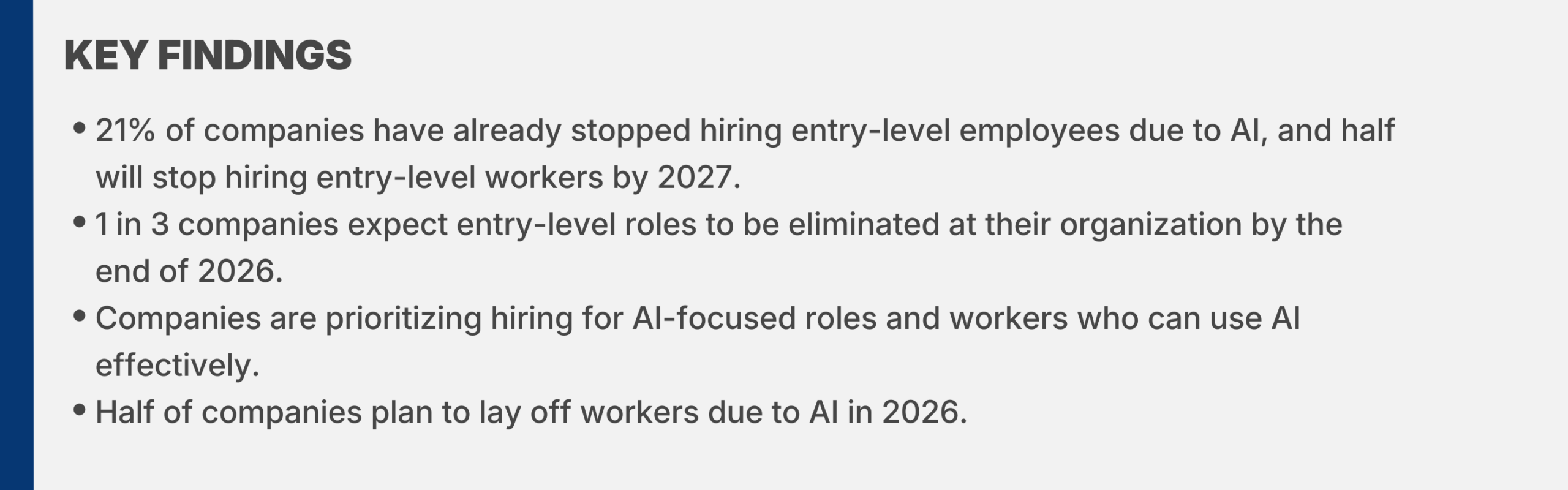
Half of Companies Will Stop Hiring Entry-Level Workers by 2027
According to the survey, 21% of companies have already frozen entry-level hiring due to AI. This is striking on its own, but the trajectory is what should concern anyone entering or advising those entering the workforce.
By the end of 2026, 36% of companies say they will have frozen entry-level hiring. Looking ahead one more year, nearly half (47%) expect to halt entry-level hiring by 2027.
AI is a central driver of these decisions. Twenty-one percent of companies say AI is the sole reason for eliminating roles, 19% say it is the primary driver, and 26% say it is one of several contributing factors.
1 in 3 Expect AI To Eliminate Entry-Level Roles by the End of the Year
There is a clear distinction between pausing hiring and eliminating roles. The survey indicates companies are doing both.
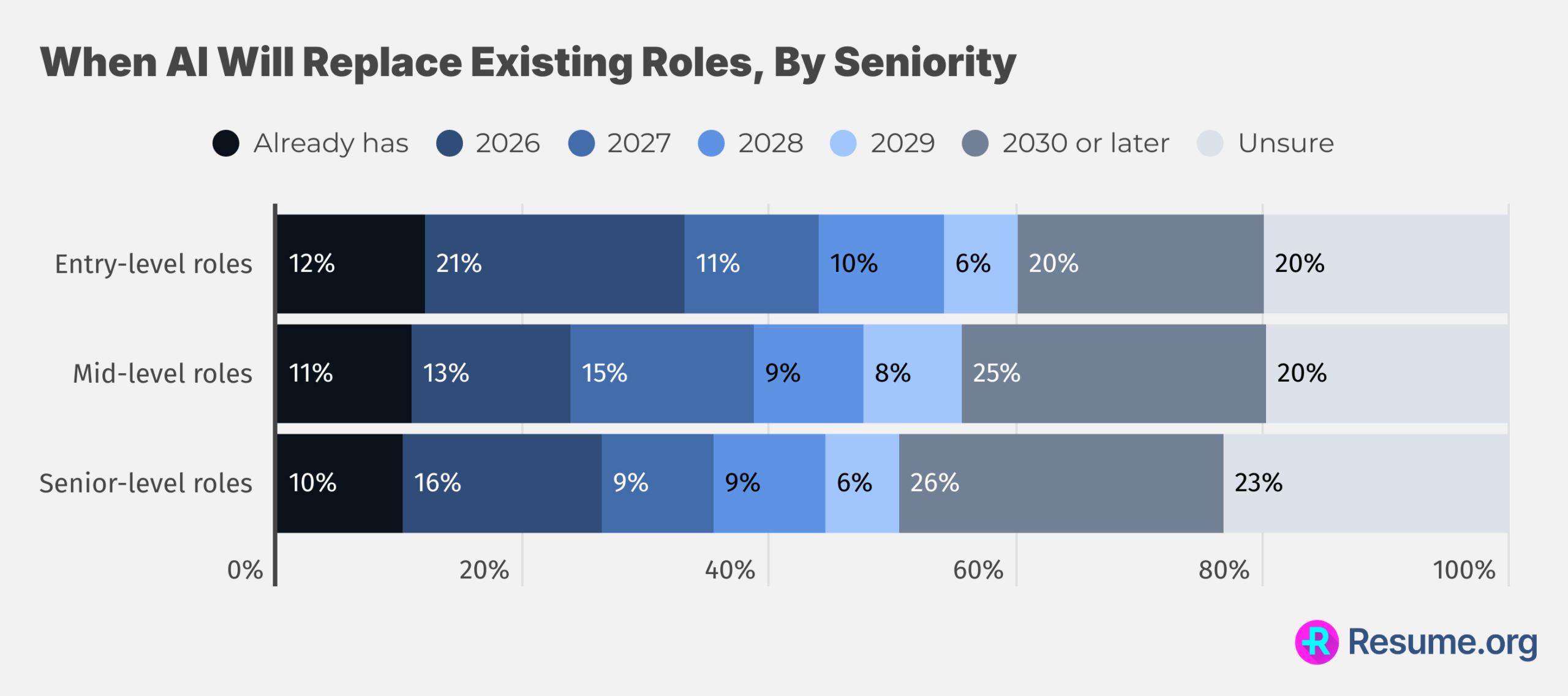
Twelve percent of companies say AI has already eliminated entry-level roles at their organization. Another 21% expect those eliminations to occur before the end of this year. Combined, a third of companies are on track to have restructured away entry-level positions by December 2026.
Senior and mid-level roles are not immune, though the timeline appears more extended. About 11% of companies have already eliminated mid-level roles due to AI, and 10% have done the same with senior-level positions. By year’s end, those figures are projected to reach 24% for mid-level and 26% for senior-level roles.
When replacing roles with AI, CEO of MedMart David Fesman suggested that businesses should start with their most repetitive administrative tasks and measure actual time savings over a 90-day period.
Using this model, MedMart was able to eliminate data entry positions with AI. According to Fesman, “That freed up the budget to hire someone more experienced whose judgment we needed more than another data entry position.”
“AI is increasingly capable of pattern recognition, forecasting, reporting synthesis, compliance monitoring, and even strategic scenario modeling, work traditionally owned by mid and senior leaders,” explains Kara Dennison, head of career advising at Resume.org.
“Many senior roles exist to interpret data, make recommendations, and allocate resources. AI now accelerates and centralizes those capabilities, reducing the need for layered management. The future favors senior leaders who leverage AI to amplify strategic thinking, not those whose value is rooted in analysis alone.”
Companies Are Still Hiring Aggressively—for Workers Who Can Use AI
Hiring has not stopped altogether. Instead, priorities have shifted.
About half (47%) of companies say they are hiring more technical or AI-focused employees this year, and 48% are hiring more workers who can effectively use AI tools.
“Employees without AI skills risk being sidelined as technologies augment or replace traditional functions,” says Dennison. “AI skills matter for two reasons: relevance and leverage. At a basic level, understanding how to use AI tools improves productivity and quality of work. At a strategic level, workers who can design prompts, interpret AI outputs, manage AI-augmented workflows, and integrate models into business processes differentiate themselves in a competitive labor market.”

Half of Companies Plan Layoffs in 2026 Due To AI
More than half (51%) of business leaders say their company will lay off existing workers in 2026 specifically because AI is consolidating or eliminating roles. Twenty-nine percent say they already have. Twenty-two percent say they plan to.
To protect their jobs and remain hirable, Dennison advises workers to do the following:
1) Build AI fluency: Learn how to use AI tools to automate workflows, improve output quality, and drive efficiency in your function. Don’t just use AI. Document the measurable impact.
2) Quantify results: In a changing and consolidating workforce, leaders protect employees who directly tie their work to revenue, cost savings, risk mitigation, or growth.
3) Strengthen strategic visibility: Communicate how you think, not just what you do. Those who influence decisions, collaborate cross-functionally, and adapt quickly are harder to replace.
4) Invest in continuous upskilling: The safest position isn’t “indispensable,” it’s adaptable.
Methodology
This survey was conducted by Resume.org on a market research platform in February 2026. The sample consisted of nearly 1,000 U.S. business leaders who met the following criteria:
- Role: C-suite or executive (CEO, COO, CFO, etc.) or VP/Director level
- Decision-making authority: Respondents who make final hiring and workforce decisions, or who influence or contribute to those decisions; those without hiring involvement were excluded
- Employment status: Employed full-time
- Income: $100,000 or more annually
- Education: Bachelor’s degree or graduate/professional degree
- Age: 30 to 70
Quality control: The survey employed in-step targeting, meaning respondents were required to pass each qualifying question before proceeding. An attention-check question (identifying which option was not an AI chatbot) was used to screen for engaged respondents.
Percentages are rounded to the nearest whole number. Some questions allowed multiple responses. The margin of error for a sample of n=933 at the 95% confidence level is approximately ±3.2 percentage points.
Resume.org offers free, HR approved resume templates to help you create a professional resume in minutes. Choose from several template options and even pre-populate a resume from your profile.