
Even as companies report planning to hire next year, many are simultaneously planning to reduce headcount.
Resume.org’s latest survey of 1,000 U.S. hiring managers found that:
- 92% of companies plan to hire in 2026, with 86% hiring in Q1
- 55% of companies expect layoffs in 2026, including 48% who say layoffs will definitely or probably occur in Q1
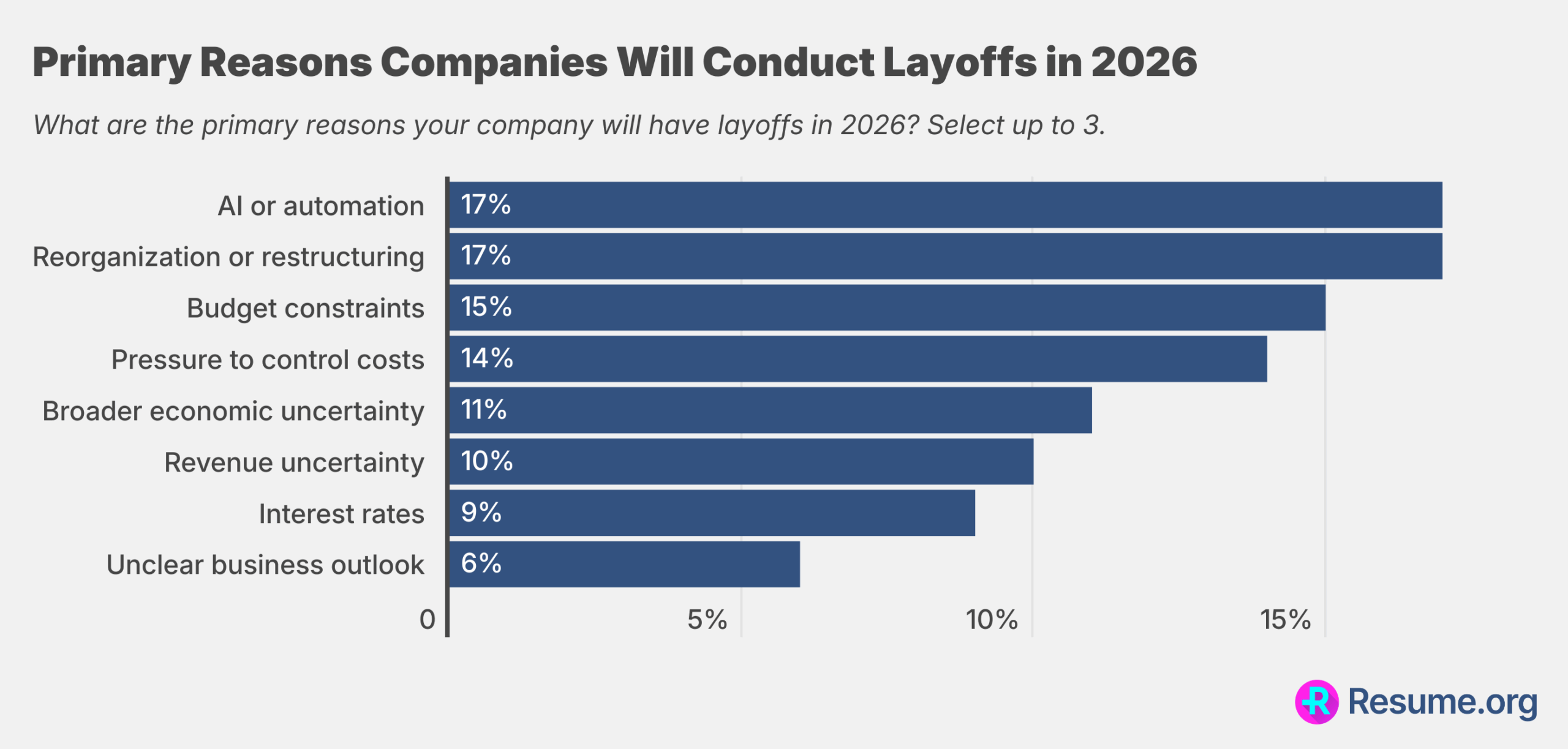
- Companies cite AI (44%), reorganization/restructuring (42%), and budget constraints (39%) as the top drivers of layoffs
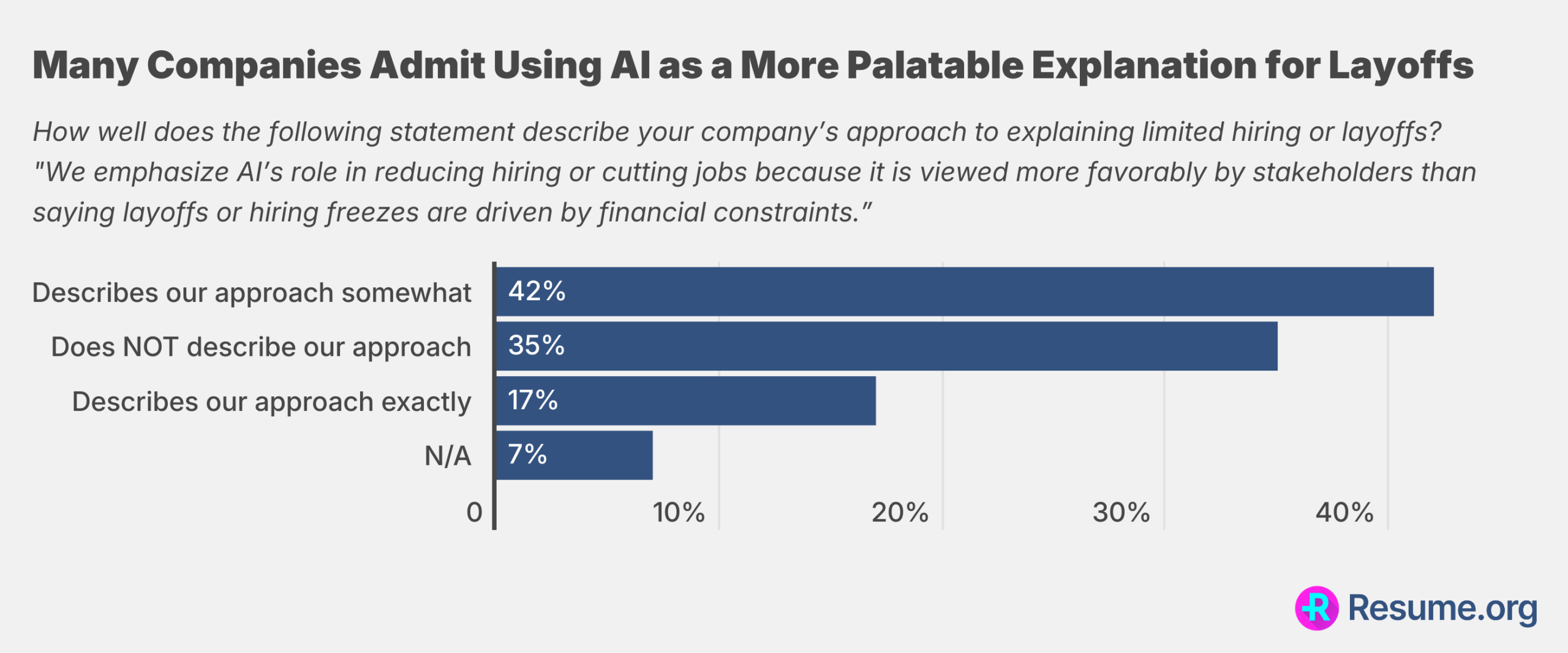
- 59% admit they emphasize AI when explaining hiring freezes or layoffs because it plays better with stakeholders than citing financial constraints
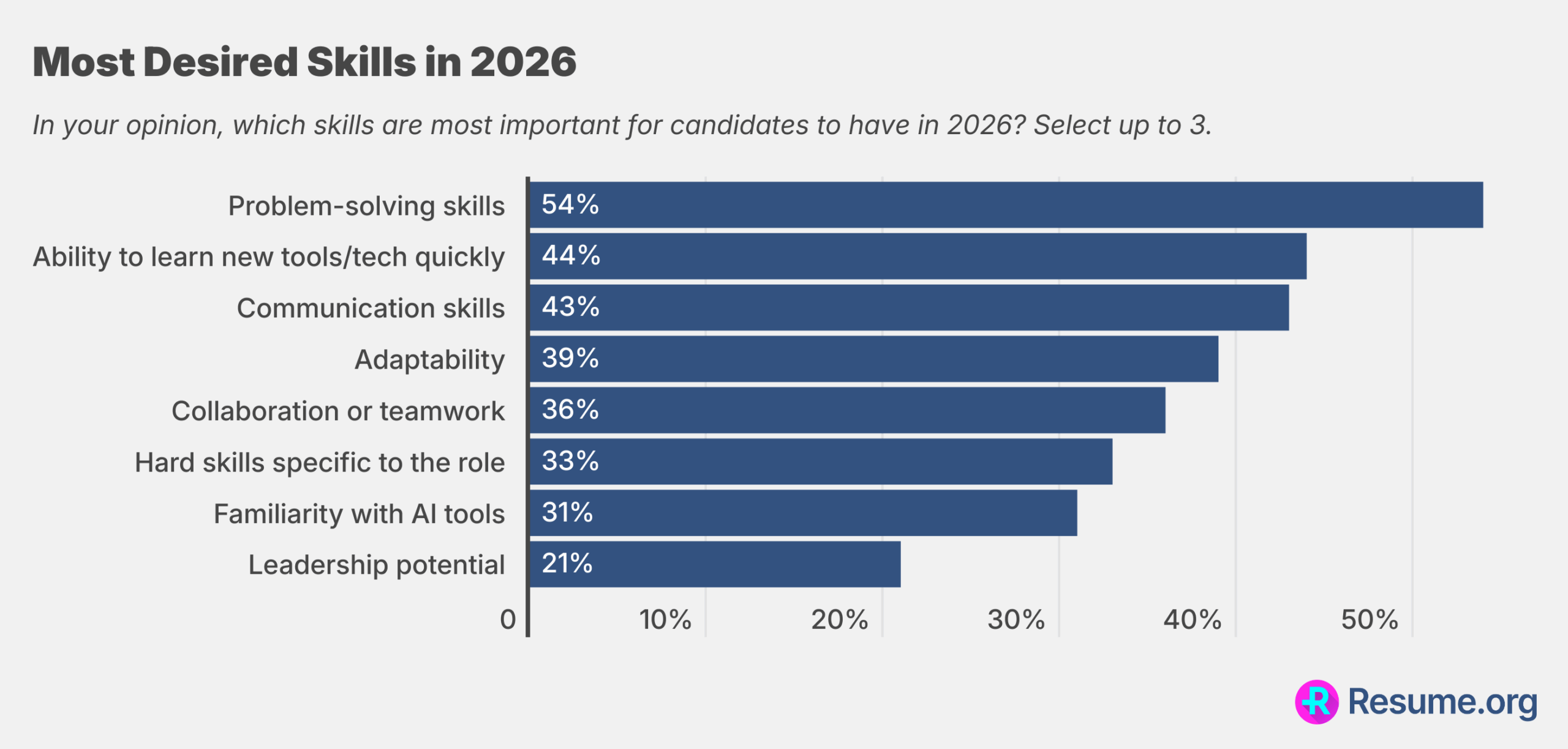
- The top skills companies say candidates need to get hired in 2026 are problem-solving (54%), the ability to learn new tools quickly (44%), and communication skills (43%)
9 in 10 Companies Plan To Hire in 2026
Hiring intentions remain strong heading into 2026, with 92% of companies planning to hire. Most companies expect to move quickly, as 86% plan to hire in Q1, while another 6% say they will hire by the end of 2026.
However, companies that are holding back cite financial caution as the primary reason, with the top barriers being budget constraints (48%), revenue uncertainty (39%), and pressure to control costs (38%).
6 in 10 Companies Will Conduct Layoffs in 2026
Layoffs remain widespread in 2026 workforce planning: 48% of companies say they will definitely (17%) or probably (31%) conduct layoffs in Q1, and another 8% expect layoffs later in 2026.
Companies cite AI (44%), reorganization/restructuring (42%), and budget constraints (39%) as the primary drivers behind these cuts, suggesting that layoffs are not tied to a single factor but are part of broader restructuring and cost-control strategies.
“What we are seeing is workforce rebalancing. Companies are laying off in areas that no longer align with near-term priorities while hiring aggressively in functions tied to revenue, transformation, and efficiency,” says Resume.org’s Head of Career Advising, Kara Dennison.
“Most organizations are reducing roles that are higher-cost, slower to yield ROI, or misaligned with new operating models. That often includes layers of middle management, duplicated functions after reorganizations, and roles tied to legacy processes. At the same time, they’re investing in roles that support growth, automation, data, customer retention, and execution speed.”
Dennison notes that for job seekers, the takeaway is that hiring is happening, but it is highly selective, as companies are buying capability, flexibility, and impact, not titles or tenure.
AI Is Impacting Staffing Needs, But It’s Also Being Used as an Excuse
AI is influencing staffing decisions, but most companies aren’t experiencing the dramatic job replacement narrative that often gets pushed. Only 9% say AI has fully replaced certain roles, while nearly half (45%) say it has partially reduced the need for new hires, suggesting companies are using AI more as a hiring slowdown tool than a true workforce substitute. At the same time, 45% report that AI has had little to no impact on staffing levels, underscoring the uneven and limited effect it actually has across organizations.
6 in 10 companies admit they highlight AI to make hiring freezes or layoffs more palatable
Many companies admit they frame layoffs or hiring slowdowns as AI-driven because it plays better with stakeholders than saying the real reason is financial constraints. Nearly 6 in 10 companies report doing this, including 17% that claim to do it exactly, and 42% that say they do it somewhat.
“AI has become an explanation because it sounds strategic, forward-looking, and inevitable. AI suggests progress rather than problems. Saying roles are being affected by AI signals innovation and modernization, while acknowledging financial strain can raise concerns among investors, employees, and customers,” says Dennison.
“However, employees are far more perceptive than companies give them credit for. When AI is used as a blanket explanation, but workloads do not meaningfully change, trust erodes quickly. People begin to question the transparency of leadership, its long-term stability, and whether future decisions will be communicated honestly. Over time, companies may find they have protected their narrative externally while damaging morale and retention internally.”
Companies Want Problem Solvers Who Can Learn Fast in 2026
Companies overwhelmingly say problem-solving skills will be the most important skill for candidates in 2026, with 54% selecting it in their top three. Next, employers prioritize the ability to learn new tools and technologies quickly (44%) and communication skills (43%), indicating that learning agility and strong interpersonal skills are nearly as important as raw competence.
Adaptability (39%) and collaboration/teamwork (36%) also rank highly, reinforcing that companies seek candidates who can adapt and work effectively with others. While familiarity with AI tools (31%) is considered important, it ranks below broader, more foundational skills, suggesting employers see AI as a useful capability but not a core requirement. Meanwhile, leadership potential trails behind at 21%, indicating most companies are still focused on practical, day-to-day performance skills over future management readiness.
Methodology: Resume.org conducted a survey of 1,000 U.S. hiring managers using Pollfish, an online market research platform that employs random device engagement sampling (RDE) to recruit respondents. This approach is designed to reach a broad, diverse sample while reducing selection bias associated with traditional opt-in panels.
The survey was fielded in December 2025. All respondents were screened to confirm their knowledge of hiring decisions at their company. Responses were collected anonymously, and quality controls were applied to ensure data validity and consistency.
Resume.org offers free, HR approved resume templates to help you create a professional resume in minutes. Choose from several template options and even pre-populate a resume from your profile.