
A new Resume.org survey finds creative skills have surpassed technical ones in perceived value, and most employers believe creative workers are harder for AI to replace.
The survey of 991 U.S. hiring managers found:
- 57% of hiring managers say an employee with strong creative thinking, communication, and storytelling skills is more valuable than one with strong technical skills, such as coding. Only 26% say the opposite.
- 57% say creative employees are harder to replace with AI than technical workers.
- Coding is most often cited as the skill that has become less valuable over the past five years.
- Creative skills are valued most in the financial services and tech industries.
Creative Skills Are Now More Valued Than Coding
The conventional wisdom that technical skills are the surest path to career security is being challenged. When asked to compare an employee with strong creative thinking, communication, and storytelling abilities to one with strong technical skills like coding or advanced programming, hiring managers favored the creative worker by a wide margin.
Fifty-seven percent say the creative employee is more valuable in today’s workforce, compared to just 26% who say the technical employee is more valuable. About 17% say they’re about the same.
Coding has seen the steepest drop in value
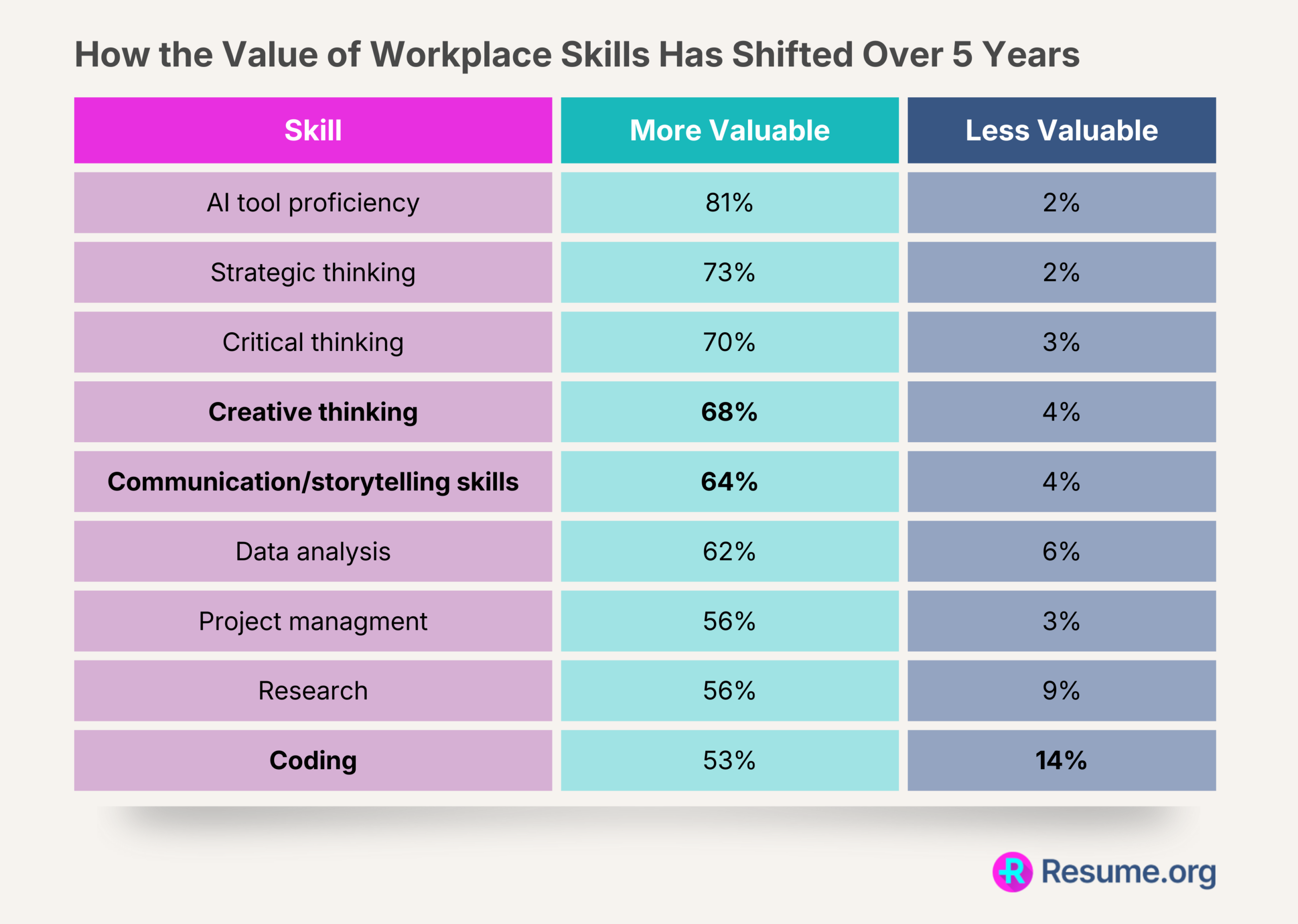
When asked how various skills compare in value today versus five years ago, coding is the only skill that a meaningful share of hiring managers say has become less valuable. Fourteen percent say coding is less valuable today than it was five years ago, a figure significantly higher than for any other skill.
Meanwhile, 81% say AI tool proficiency is more valuable today than 5 years ago, while 73% say the same about strategic thinking. Creative thinking (68%) and communication and storytelling (64%) also ranked among the top skills that have grown in value.
Why Creative Skills Are Winning: AI Can’t Replicate Them
Overall, hiring managers see creative work as more AI-resistant. When asked which type of employee would be harder to replace with AI, 57% pointed to the creative employee, nearly double the 31% who said the technical employee would be harder to replace.
This is a notable shift in how employers are thinking about AI’s reach. As AI tools have grown more capable at generating code and performing technical tasks, human skills like creativity, communication, and storytelling appear to be rising in perceived irreplaceability.
When just looking at the share of hiring managers who said creative employees are more valuable than technical workers, three-quarters (76%) say it’s because their skills are hard for AI or automation to replicate.
Reasons hiring managers believe creative jobs are more AI-resistant:
- 76% say creative skills are difficult for AI or automation to replicate.
- 72% say creative employees contribute more to strategy and decision-making.
- 69% say creatives translate complex ideas into clear insights or narratives.
- 51% say creatives help refine, edit, and improve AI-generated content.
The picture that emerges is one where creative employees are seen as essential, not in spite of AI, but because of it, as the human layer that makes AI output useful, strategic, and communicable.
“The value of coding skills is shifting because AI can now perform many technical tasks faster and at scale. AI tools can generate code, automate debugging, and assist with technical implementation, which reduces the scarcity that once made coding such a strong differentiator,” explains Kara Dennison, Head of Career Advising at Resume.org. “At the same time, creative thinking, communication, and storytelling are becoming more valuable because they help organizations interpret, guide, and apply AI effectively.
“Professionals who can combine technical literacy with the ability to think creatively about problems and translate complex ideas into meaningful decisions will stand out the most in the workplace.”
Which Industries Creative Skills Matter Most
Creative skills are not valued equally across industries. Financial services and technology lead in the share of hiring managers who say a creative employee today is more valuable than a technical one.
- Financial services: 66%
- Technology: 65%
- Education: 59%
- Government: 58%
- Manufacturing: 56%
Financial services ranking near the top may be surprising for an industry long associated with quantitative talent, but it reflects a broader shift: as technical tasks become increasingly automated, the ability to communicate complex ideas, build client relationships, and drive strategic decisions is becoming the differentiator.
The story looks somewhat different when the question shifts to whether creative thinking has grown in value over the past five years. Technology still leads, but healthcare and construction rise into the top five, suggesting that industries undergoing significant operational change driven by AI are increasingly recognizing the limits of technical skills alone.
- Technology: 75%
- Healthcare: 73%
- Construction: 71%
- Manufacturing: 69%
- Financial services: 67%
Companies Are Cutting and Growing Creative Roles Simultaneously
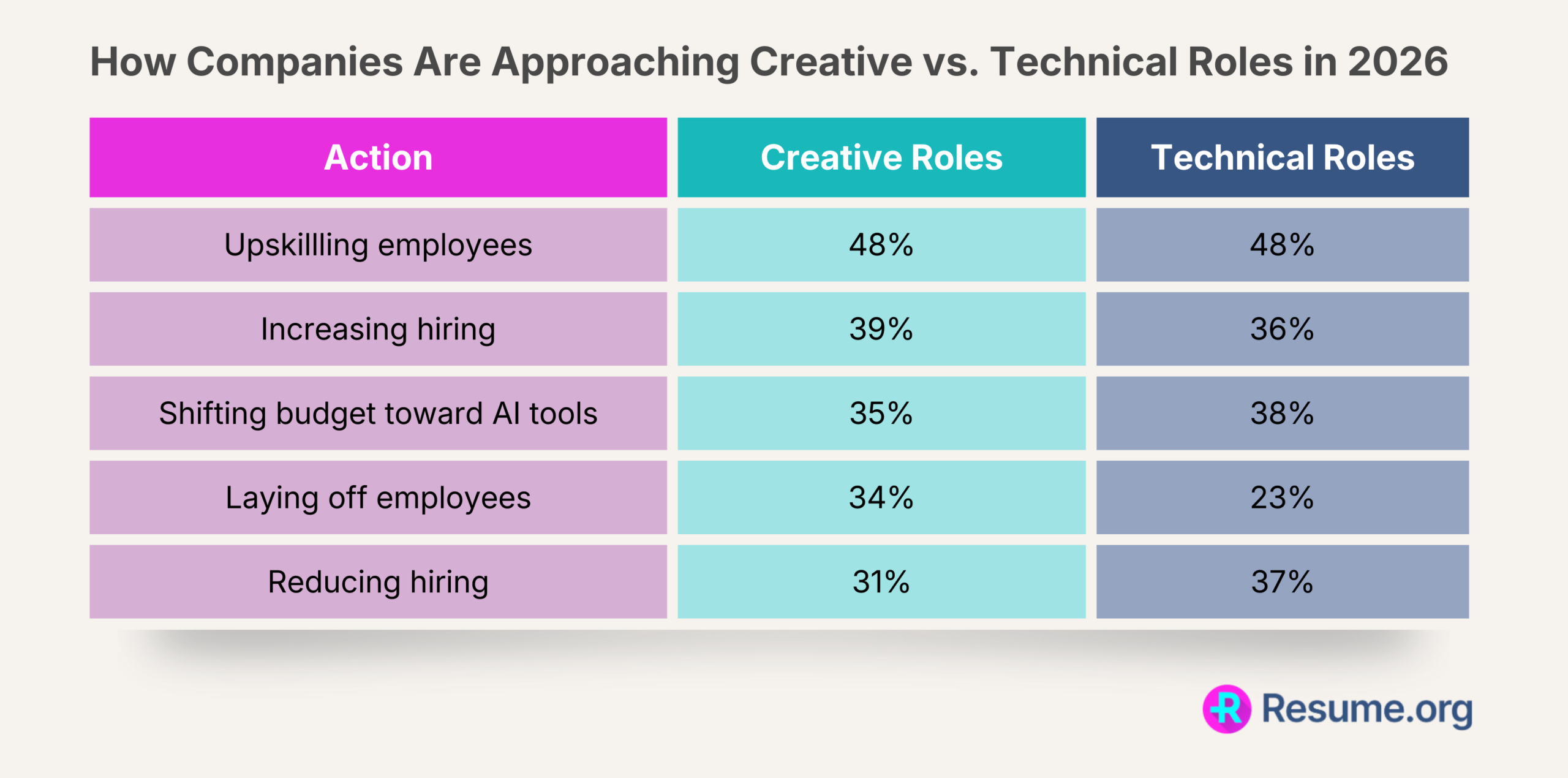
One in three companies (34%) has laid off creative employees in 2026 as a result of AI, a notably higher rate than the 23% that have laid off technical employees. But at the same time, 39% of companies say they have increased hiring for creative roles this year, compared to 36% for technical roles. And nearly half of companies (48%) are upskilling their creative workforce, the same rate as for technical employees.
The pattern suggests companies are undergoing a reshuffling of their creative teams rather than simply eliminating them, culling some roles while simultaneously investing in others.
The industries growing their creative teams most aggressively are technology (52%), manufacturing (47%), financial services (43%), and transportation and logistics (42%).
“There is a restructuring of creative work happening as many organizations eliminate production-level roles where AI can generate drafts, designs, or basic content quickly,” says Dennison. “At the same time, companies are increasing hiring for higher-level creative roles that focus on strategy, narrative development, brand voice, and translating complex ideas into clear messaging. Companies still need people who can guide the story, interpret insights, shape positioning, and ensure AI-generated output actually resonates with customers and stakeholders. The creative roles that will remain are more strategic, human-centered, and AI-integrated.”
Methodology
Resume.org surveyed 991 U.S. hiring managers on March 4, 2026, using the Suzy consumer research platform. To qualify, respondents had to be employed full-time, between the ages of 30 and 70, and hold a household income of at least $100,000. All respondents were actively involved in hiring decisions at their organizations and held senior-level roles: VP or Director (40%), C-suite or Executive (37%), or Senior Manager (22%). Respondents represented a range of industries.
Resume.org offers free, HR approved resume templates to help you create a professional resume in minutes. Choose from several template options and even pre-populate a resume from your profile.