
In November, Resume.org surveyed 1,200 full-time U.S. workers to find out which job factors will matter most in 2026. This report reveals what workers want in the year ahead, where employers are meeting expectations, and where there are clear opportunities for improvement.
What’s Most Important to Workers for 2026
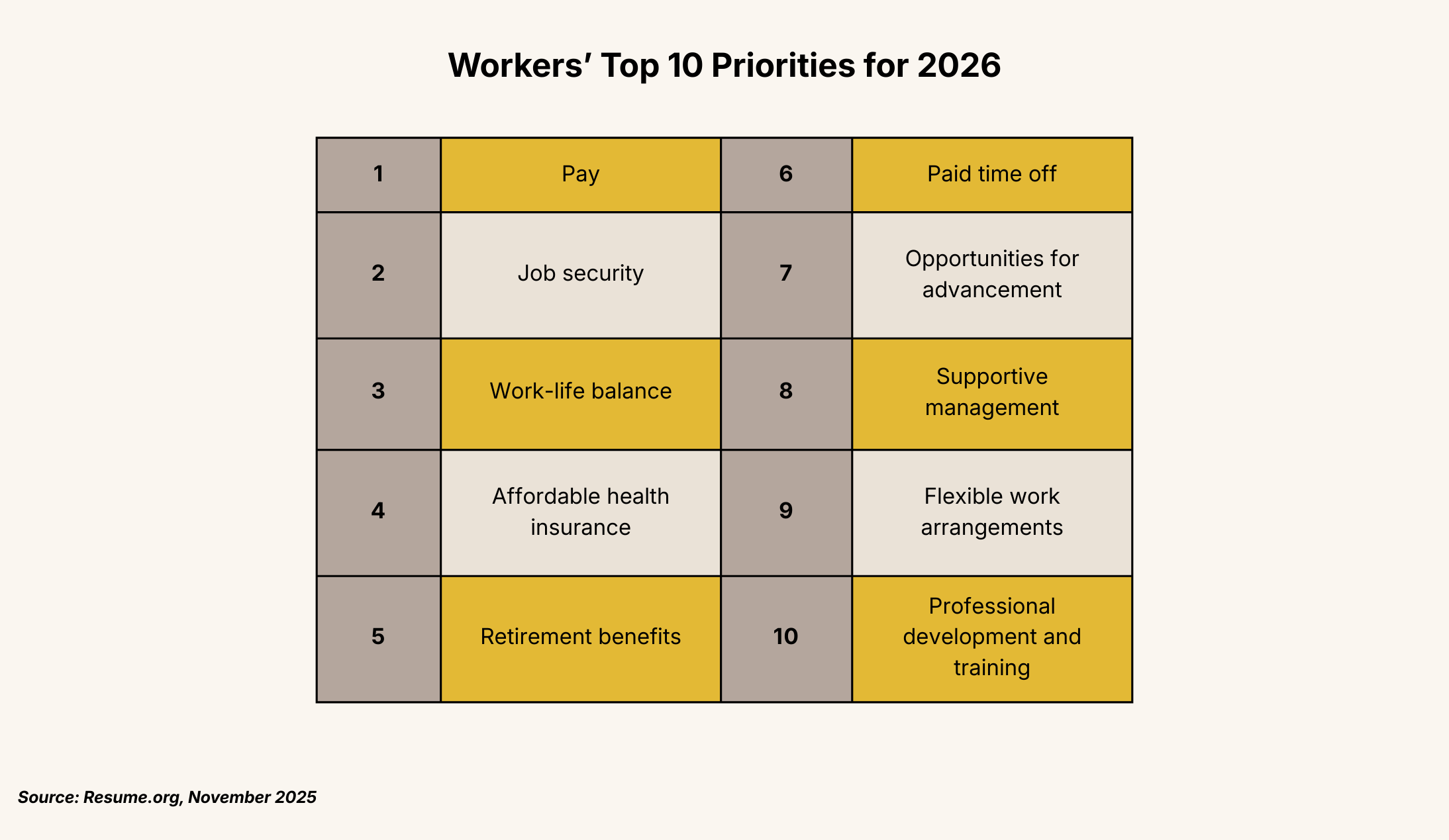
1. Pay
Pay is workers’ top priority for 2026. In their current roles, 20% say they are very satisfied with their pay, and 48% say they are satisfied. However, more than one-third of workers don’t feel satisfied with their current compensation.
2. Job security
Job security is workers’ second-highest priority. Although most workers feel reasonably secure, about 11% feel exposed to uncertainty in their current role. At the moment, 30% report feeling a great deal of job security, and 40% say they feel a fair amount. Another 19% say they feel a moderate amount of job security, while 8% feel they have a little job security, and 3% believe they have none at all.
3. Work-life balance
Work-life balance ranks third among workers’ priorities. About one-third of workers view their work-life balance as something that could be improved. Today, 21% say their work-life balance is excellent, and 46% say it is good. However, 25% describe their work-life balance as fair, and 8% say it’s poor (6%) or very poor (2%).
“It’s no surprise that pay, job security, and work-life balance are most important to workers in 2026,” says Kara Dennison, Head of Career Advising at Resume.org. “These priorities reflect what people need to feel stable, valued, and able to plan their lives. Pay matters because it shapes overall financial well-being as housing, healthcare, and everyday costs rise. Job security has become a bigger focus after years of layoffs and restructuring. And work-life balance remains essential as workers prioritize their health, family needs, and mental well-being. Together, these priorities show that employees want both financial stability and a work experience that feels sustainable.”
4. Affordable health insurance
Affordable health insurance is the fourth priority for workers. Nearly half of workers feel their coverage could be more affordable. Right now, 15% of respondents report that the affordability of their health insurance is excellent, and 35% say it is good. However, 29% describe affordability as fair, and 18% say it is poor (11%) or very poor (6%). An additional 4% do not have health insurance at all.
5. Retirement benefits
Retirement benefits rank fifth on workers’ priority list as they head into 2026. More than one-third of workers feel their retirement offerings are average or below. Today, 13% say their retirement benefits are excellent, and 41% say they are good. Meanwhile, 28% describe their benefits as fair, and 11% say they are poor (8%) or very poor (3%). Another 7% report that their role does not offer retirement benefits at all.
6. Paid time off
Paid time off is the sixth most important factor for workers. While PTO satisfaction is stronger than several other benefits, more than one in 10 workers still feel it falls short. At the moment, 23% say they are very satisfied with their PTO, and 47% say they are satisfied. However, 17% feel neutral, and 11% are dissatisfied (8%) or very dissatisfied (3%). A further 4% say their role does not offer paid time off.
7. Opportunities for advancement
Opportunities for advancement rank seventh among workers’ priorities. Nearly one-quarter of workers feel they lack clear paths for career advancement. In their current roles, 13% say advancement opportunities are very sufficient, and 39% say they are sufficient. However, 27% feel neutral, and 22% say opportunities are insufficient (16%) or very insufficient (6%).
8. Supportive management
Supportive management is the eighth highest priority. Although most workers feel supported, a notable minority describe management as neutral or unsupportive. Today, 23% say management is very supportive, and 47% say it is supportive. Another 19% feel neutral, and 11% say their management is unsupportive (8%) or very unsupportive (3%).
9. Flexible work arrangements
Flexible work arrangements, such as being able to work remotely, rank ninth overall. More than one-third of workers view their flexibility as average or below, and some do not receive flexibility at all. Currently, 18% report that their flexibility is excellent, and 33% indicate that it is good. However, 20% describe their flexibility as fair, and 15% say it is poor (11%) or very poor (4%). An additional 13% say their role does not offer flexible work options.
10. Professional development
Professional development ranks tenth. Although most workers feel their development opportunities are sufficient, more than one in 10 say they’re not. Today, 15% say their training opportunities are very sufficient, and 48% say they are sufficient. Meanwhile, 24% feel neutral, and 13% say their opportunities are insufficient (10%) or very insufficient (3%).
Desires Shift Based on Gender and Age
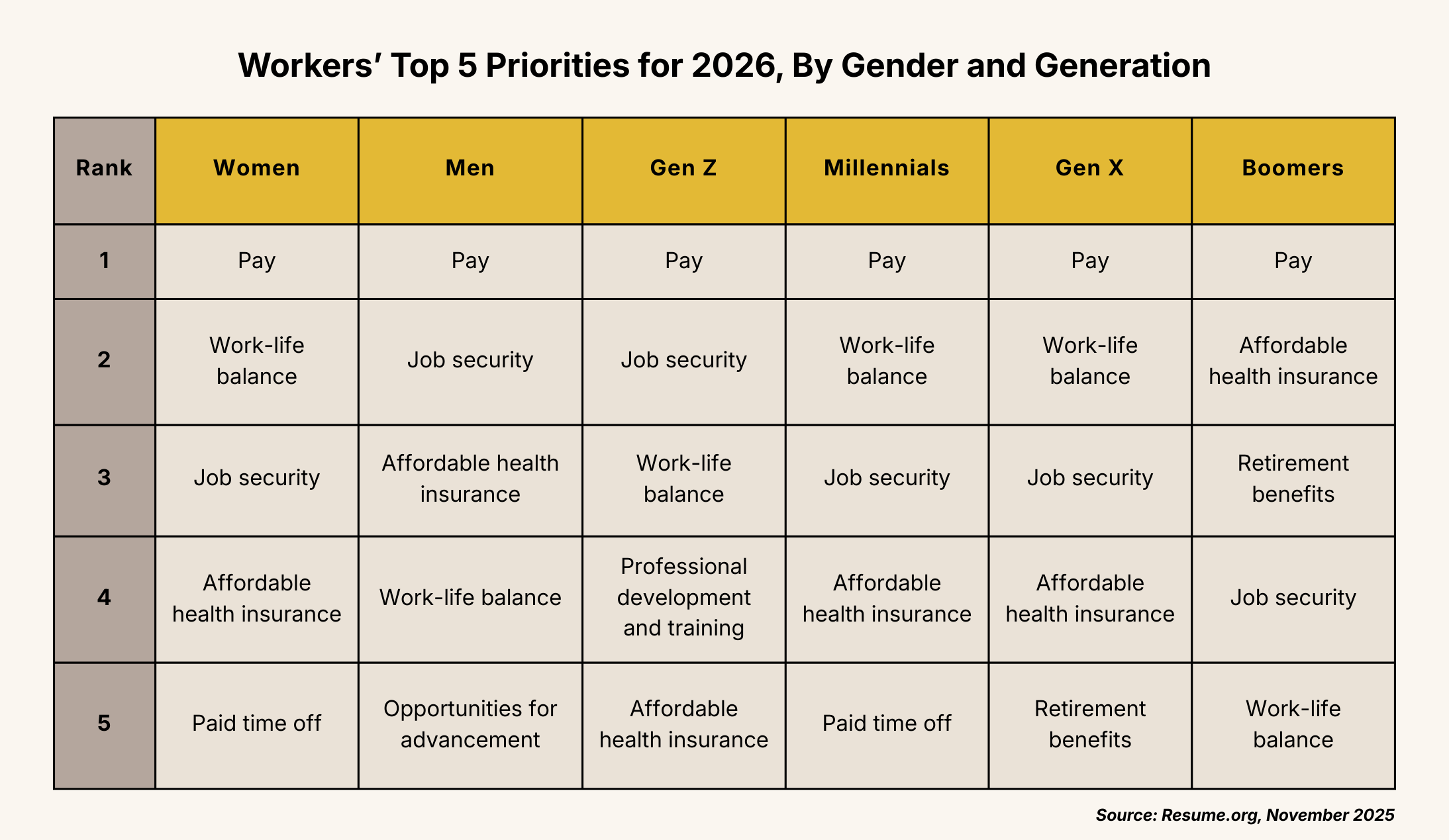
Across genders and generations, pay is the clear top priority for everyone. Job security and work-life balance also consistently land near the top, but the order shifts depending on the group. Women prioritize work-life balance over job security, while men rank job security first and work-life balance slightly lower. Men also place a higher value on affordable health insurance than women, suggesting they may feel more pressure regarding coverage costs. Women rank paid time off and supportive management earlier than men, indicating a stronger connection to daily quality-of-life factors.
Generational differences are even more pronounced. While pay is a priority across every age group, older workers place a particularly strong emphasis on stability. Baby Boomers rank affordable health insurance and retirement benefits among their top concerns, underscoring how financial protection becomes increasingly central later in their careers. Gen X mirrors this pattern, though with slightly more emphasis on work-life balance.
Younger workers show a different set of priorities. Gen Z ranks job security and work-life balance near the top, but places professional development and advancement opportunities higher than any other generation. Millennials fall in between, valuing pay, balance, and security but also showing more interest in growth than older workers. These differences reflect how expectations shift as workers progress through the stages of their careers and how employers may need to tailor their communication or benefits to the specific audience.
“Different genders and generations have unique priorities because they bring their own lived experiences, financial pressures, and career stages to work,” says Dennison. “Gender differences often reflect how caregiving and household responsibilities are distributed. Women may prioritize work-life balance, supportive management, and PTO because they’re more likely to juggle work and caregiving.
“Generational gaps are largely about life stages. Gen Z and Millennials are in growth mode, so they value development, advancement, and flexibility. Gen X and Boomers focus more on stability, retirement readiness, and healthcare as they manage long-term obligations or plan for retirement.”
6 in 10 Gen Z Workers Will Look for New Jobs in 2026
When asked about their plans for next year, 18% of workers say they are very likely to look for a new job, and 23% say they are somewhat likely. Another 20% aren’t sure yet.
Interest in switching jobs varies sharply by generation, with Gen Z leading the way at 57%, followed by Millennials at 45%, Gen X at 29%, and Boomers at 20%.
“Having nearly half the workforce thinking about a new role next year is a big number. People are primarily seeking better pay, increased security, a healthier work-life balance, and opportunities to grow or learn, along with a culture that genuinely supports them. And switching jobs can help workers find those things,” says Dennison.
Methodology
This research is based on a survey of 1,200 full-time U.S. workers. Respondents ranked job factors and answered satisfaction questions about different aspects of their current role. Results were post-stratified for age and gender. Percentages reflect post-stratified values.
Resume.org offers free, HR approved resume templates to help you create a professional resume in minutes. Choose from several template options and even pre-populate a resume from your profile.